

PFAS Contamination Is Present Across The Country
PFAS water contamination impacts residents in many places across the United States. The problem with PFAS and similar contaminants is that, until recently, few people knew or understood them. Compounding this issue, PFAS have become nearly ubiquitous in our environment.
The US Geological Survey (USGS) conducted a study to assess the levels of polyfluorinated alkyl substances (PFAS), often referred to as 'forever chemicals,' in tap water across the nation. Among the 12,000 types of PFAS, only 32 common types were examined due to testing limitations. They collected water samples from 716 locations throughout the country, and 13 of these sampling sites were in Colorado. The study indicated that urban areas have a higher likelihood of detecting PFAS in water sources, approximately 75 percent in urban areas compared to 25 percent in rural regions.
In Akron and surrounding Northeast Ohio communities, water utilities continue monitoring emerging contaminants as regulations evolve.
How to Remove PFAS Forever Chemicals From Your Akron/Canton Water
There is no way to completely prevent PFAS from entering the environment, but there are effective ways to reduce them in your drinking water.
Advanced filtration methods can significantly reduce PFAS, including:
Reverse Osmosis Filtration Installation
Culligan’s RO systems are highly effective at reducing PFAS. These systems use a semipermeable membrane to remove contaminants at the molecular level and can reduce a wide range of impurities in drinking water.
Whole House Water Filtration Systems
Whole home systems help reduce contaminants throughout your entire home, improving water quality at every tap. These systems can be configured to address PFAS along with other water concerns.
It’s important to note that effectiveness depends on the type and concentration of PFAS present. A professional water test is the best way to determine the right solution for your home.
Solutions
Suggested Products
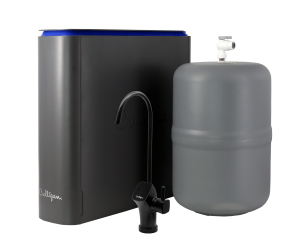
The Aquasential® Smart Reverse Osmosis Water Filter (RO)
- 7 stages of filtration and 12 filter options
- Certified for reduction of 58 contaminants
- 2-in-1 sediment and carbon filter screens out sediment and particles
- Can alert you and your dealer when service or filter replacements are needed
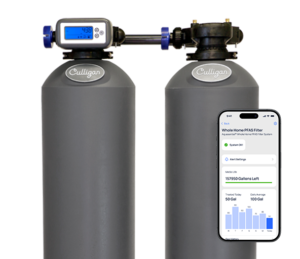
Aquasential® Whole House PFAS Water Filter
- Third-party certified to ANSI/NSF standards, the Aquasential® Whole Home PFAS Filter can reduce total PFAS by up to 99.9%.
- The PFAS filtration system operates effectively with minimal water pressure loss, even at higher flow rates.
- The built-in Smart Flow Monitor records the water treated by your system and calculates the remaining filter life, so you can always have the peace of mind that you’re getting optimal PFAS reduction.
- Easily check system performance, get alerts when filtration media needs to be changed, monitor water usage and set conservation goals using the Culligan Connect App right on your phone.
Why Is My Akron/Canton Water Contaminated With PFAS Forever Chemicals?
PFAS contamination is most often linked to historical industrial activity, manufacturing processes, and environmental runoff. In areas like Akron and Canton, these factors can influence local water sources over time, especially in regions with a long history of industrial and commercial development.
Akron’s water supply comes from surface water sources, including the Upper Cuyahoga River and connected reservoirs. Because of this, the system can be more exposed to environmental inputs. Materials that enter waterways upstream, such as urban runoff or treated wastewater, can make their way into source water before treatment.
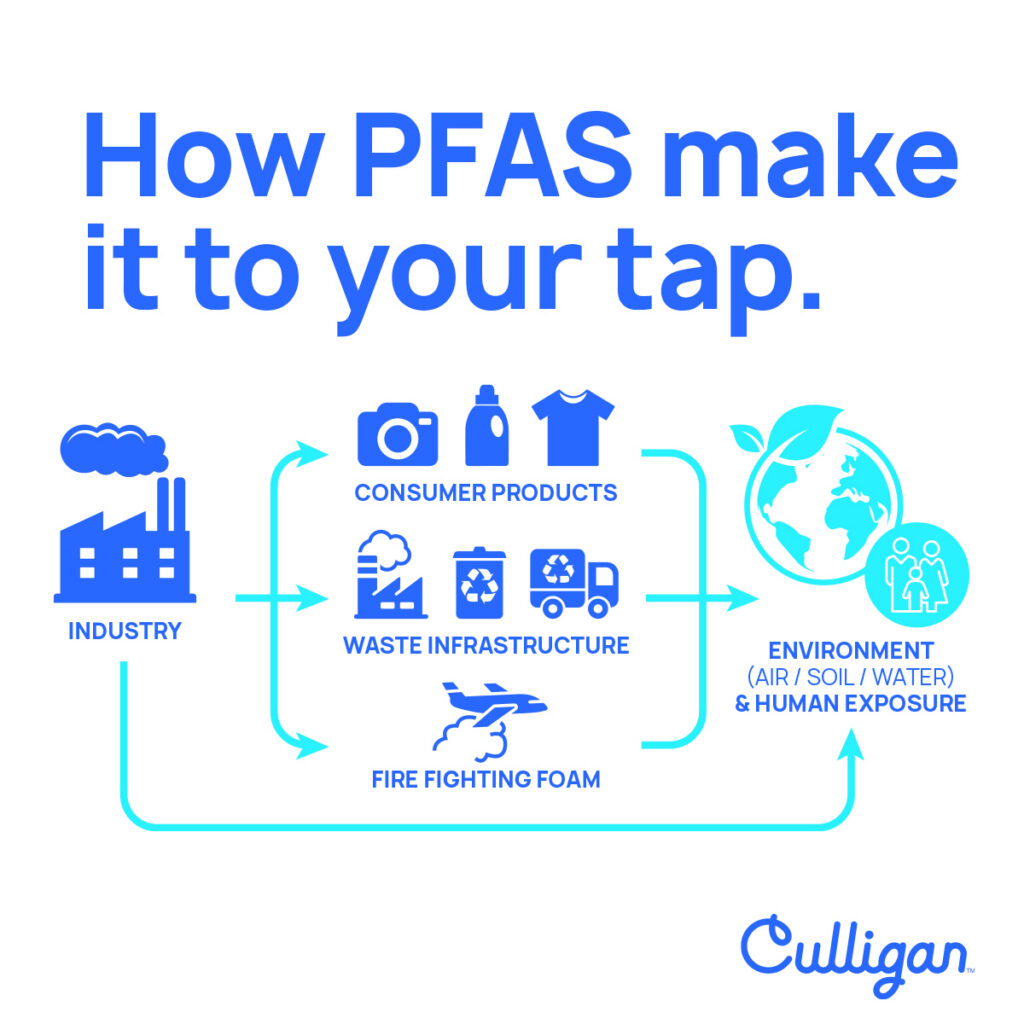
Potential contributors in the region may include manufacturing activity, landfill runoff, firefighting foam use, and stormwater moving through developed areas. These are common pathways for PFAS to enter water systems across the country.
According to the most recent Akron water quality report, PFAS results are not always clearly listed in standard Consumer Confidence Reports. This is because testing requirements and regulations are still evolving. The EPA is in the process of establishing new Maximum Contaminant Levels, and utilities are expanding monitoring efforts.
As a result, Akron’s water meets all current safety standards, but PFAS may still be present at low or emerging levels, leading homeowners to consider advanced filtration systems.
PFAS EPA Regulations and Drinking Water Standards
2024 EPA PFAS Update
On April 10, 2024, the United States government introduced its first-ever national, legally enforceable drinking water standard to protect citizens from PFAS forever chemicals. The new rules to regulate six types of PFAS chemicals were developed based on feedback from the public and stakeholders, with over 120,000 comments considered. The EPA believes that these rules will protect about 100 million people from PFAS exposure over time, prevent thousands of deaths, and reduce tens of thousands of serious illnesses related to PFAS.
The EPA has also announced that it will be offering substantial funding, including $1 billion from the Bipartisan Infrastructure Law, to help test and treat PFAS in not only public water systems but address contamination in private wells as well.
The new regulations set limits known as ‘Maximum Contaminant Levels or MCLs’ for individual PFAS like PFOA, PFOS, PFHxS, PFNA, and HFPO-DA, as well as a combined limit for mixtures of PFHxS, PFNA, HFPO-DA, and PFBS. While these regulations will help to protect from 6 PFAS, there are over 15,000 PFAS chemicals.
The new regulations state areas exceeding the new standards of PFAS contamination must take action to reduce PFAS in their drinking water within 5 years.
2026 EPA PFAS Update
On May 18, 2026, the U.S. Environmental Protection Agency announced proposed changes related to PFAS drinking water regulations. The update keeps federal drinking water limits for PFOA and PFOS in place, but it may change how certain parts of the rule are implemented.
Under the proposal, some public water systems may be able to request additional time to meet enforceable limits for PFOA and PFOS. The EPA also proposed reviewing parts of the rule related to PFHxS, PFNA, HFPO-DA, commonly known as GenX chemicals, and the PFAS hazard index.
For homeowners, the update is a reminder that PFAS regulations are still developing. Public water systems may need time to test source water, review treatment options, secure funding and install new treatment equipment. In the meantime, homeowners who are concerned about PFAS can take a more immediate step by learning more about their own water quality.
Culligan offers professional water testing and filtration solutions designed to help reduce PFAS in drinking water. Depending on your home’s water quality, treatment options may include reverse osmosis, activated carbon filtration or other advanced filtration systems.
Further Explanation On What “Forever Chemicals” Are
PFAS, commonly known as ‘Forever Chemicals,’ water contamination impacts residents in many places across the United States, including the Northeast Ohio area. The problem with PFAS and similar contaminants is that, until recently, few people knew or understood them. Compounding this issue, PFAS have become nearly ubiquitous in our environment.
It started in the early 1940s, when water and heat-resistant chemicals containing per- and polyfluoroalkyl substances were engineered to help create non-stick products (Teflon), fire retardants, and other common consumer goods. What wasn’t understood at the time, however, was that Teflon and other products using PFAS wouldn’t naturally decay in nature–or the human body.
Known as bioaccumulation, this chemical characteristic means any amount absorbed in our bodies – through eating or drinking – stays in our bodies. Since we have no way of removing or disposing of these chemicals, they’ve earned the ominous nickname, ‘forever chemicals.’ As a result, most PFAS have been phased out of use in this country. But they remain prevalent in the environment, and this includes our water supply.
What About PFOA? Where Are They Found?
PFOA, the most notable substance of the PFAS family, was found to be a part of the manufacturing process of Teflon. The EPA sued DuPont in 2005 for failing to report a health risk to both humans and the environment. The company paid a $10.25 million settlement.
Because of PFOA and PFAS strong molecular structure, they take much longer to break down naturally than other organic chemicals.

Until 2002, PFOA were integral in producing goods which qualities repel dirt, grease, water and stains.
These contaminants can be found in the manufacturing process of a variety of products, including non-stick cookware, carpet-care liquids, treated apparel, upholstery or textiles, sealants, dental floss, floor wax and non-woven medical garments. Though PTFE non-stick cookware was proven to have PFOA levels, a recent study found levels that ranged from undetectable to 4.3 parts per billion, and it is not currently considered a major pathway for PFOA.
In 2019, United Nations experts recommended banning PFOA globally at the Stockholm Convention on Persistent Organic Pollutants. Will the United States follow suit based on recent outbreaks in Texas and Michigan?
Problems with PFOA
According to a study, people who lived in the PFOA-contaminated area around DuPont’s Washington Works facility were found to have higher levels of PFOA in their blood from drinking water. People that drank more tap water, ate locally grown fruits and vegetables, or ate local meat, were all associated with having higher PFOA levels.
Residents who used carbon filter systems had lower PFOA levels. Studies have found that using carbon-activated filters can reduce PFOA by up to 60%.
PFAS Connection To Testicular Cancer
A government funded report published by the National Academies of Sciences, Engineering and Medicine found strong evidence that being exposed to PFAS could lead to health issues like weaker vaccine responses, kidney cancer, and underweight newborns. They suggested that areas with high PFAS exposure should do blood tests and health checkups for people with significant exposure. The report also noted a probable link, though with less certainty, between PFAS exposure and thyroid issues, pregnancy-related preeclampsia, and certain types of cancers.
A recent study focusing on Air Force service members was released in July of this year. This study went even further, directly connecting PFAS exposure to a specific type of testicular cancer that makes up around 95% of cases.
Testicular cancer is the most common cancer among young adult men. Among those in the military, especially men aged 18 to 40, are the most frequently diagnosed cancer. To prove this connection, researchers used samples from over 62 million service members’ blood collected between 1988 and 2017. They looked at samples from 530 troops who later got testicular cancer and 530 who did not. A second round of sampling four years later showed that higher levels of PFAS were linked to a higher risk of testicular cancer.
Popular Brands Contaminated with PFAS Forever Chemicals
According to the Agency for Toxic Substances and Disease Registry, PFAS, known for their oil and water resistance, non-stick, and fire-resistant qualities, are commonly added to various everyday products used by most Americans such as the following:
- Cosmetics
- Food packaging: take out containers, food wrappers
- Non-stick pans (Teflon)
- Carpets, rugs, furniture textiles, window treatments, car seats
- Stain and waterproof clothing
- Outdoor gear
- Umbrellas
- Dental Floss
- Microwaveable popcorn bags
- Firefighting foam and personal protective gear
- And more.
Simply Orange Juice PFAS Contamination
A class action lawsuit alleges Simply Tropical and Simply Orange beverages have been promoted as “All Natural” and made with “all-natural ingredients.” Nevertheless, the lawsuit contends that lab tests conducted on Simply Tropical contradict these claims, revealing the presence of PFAS, artificial chemicals that are not natural.
PFAS Contamination In Lululemon
An analysis by Toxic-Free Future tested 60 items from various categories, discovering that 35 products, mostly leggings and yoga pants, had fluorine levels exceeding 100 parts per million, a strong PFAS indicator. Among the brands tested were Lululemon and Old Navy. Of these, three-quarters contained banned long-chain PFAS compounds. Notably, 28% of the tested products contained PFAS, with 34 out of 47 items with water-resistance claims showing PFAS presence. An additional investigation also found PFAS in popular sportswear brands, raising questions about long-term exposure risks associated with PFAS-coated clothing.
Forever Chemicals in Menstrual Products
The Thinx underwear brand was involved in a lawsuit alleging their products contained PFAS after the marketed their products as a safe, sustainable product, free of harmful chemicals. The period underwear company has settled a lawsuit regarding allegations of inadequate product effectiveness and misleading advertising.
PFAS In Sparkling Water
According to Green Matters, Consumer Reports detailed the levels of PFAS found in many popular carbonated water brands contain. Topo Chico, owned by Coca-Cola Co., was an extreme outlier containing 9.76 parts per trillion. Most brands tested were only slightly above 1 part per trillion, with Poland Spring at 1.66, Canada Dry at 1.24, LaCroix at 1.16 and Perrier at 1.1. As for non-carbonated water, Deer Park tested at 1.21 parts per trillion.
Recommendations by the EPA
The EPA regulates drinking water standards and has established enforceable limits for certain PFAS compounds. Current standards set Maximum Contaminant Levels (MCLs) of 4 parts per trillion (ppt) for PFOA and PFOS, along with additional guidelines for other PFAS chemicals.
While utilities are working to meet these new standards, many homeowners choose to explore filtration options to reduce PFAS in their drinking water.
To put this into perspective, comprehending the scale of a part per trillion is essential. Picture one ppt as a single droplet of water dispersed across 20 vast Olympic-sized swimming pools or one second in 32,000 years.

Facebook